 GONGYI BAOYUAN MACHINERY.CO.LTD


ИЩИТЕ ТО, ЧТО ХОТИТЕ
Искать всеПродуктНовости
ПОИСК
Continuous charcoal making machine is an industrial equipment used for high-temperature carbonization of materials. It adopts a continuous feeding and discharging working mode to achieve efficient carbonization of raw materials such as biomass and organic waste. Compared with traditional intermittent carbonization furnaces, continuous carbonization furnace has significant advantages such as high production efficiency, high energy utilization, and stable product quality. It has been widely used in biochar preparation, activated carbon production, waste resource utilization and other fields.
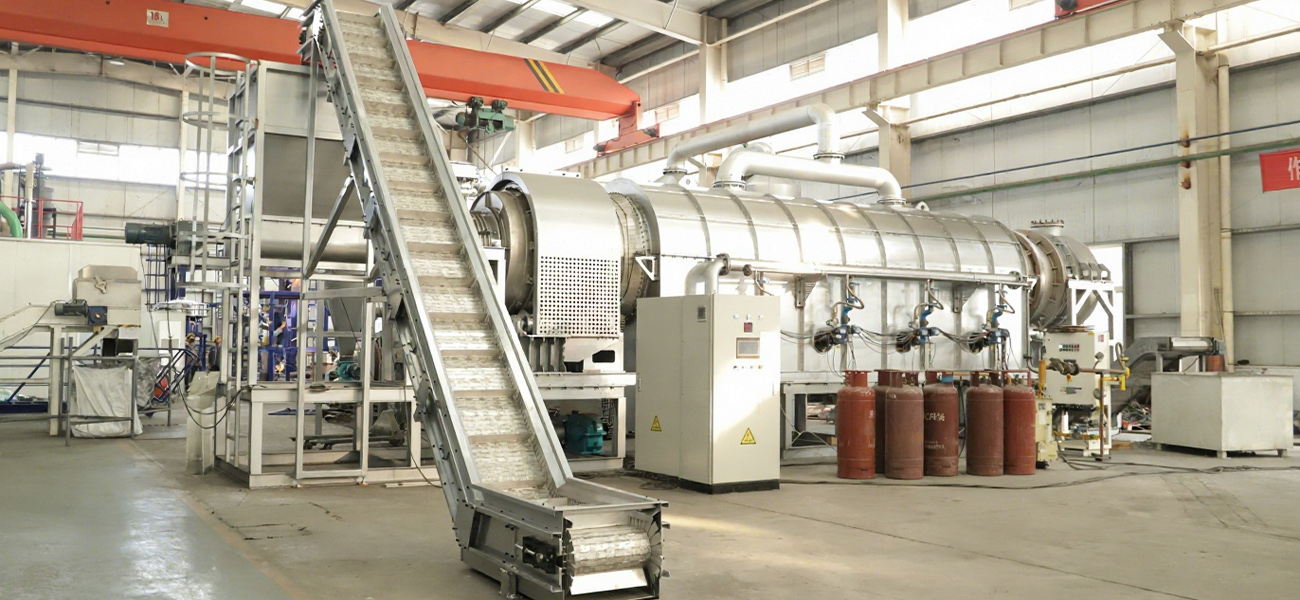
Xuye continuous charcoal making machine provides customers with a set of efficient and environmentally friendly charcoal making solutions. Using a continuous carbonization process, the entire production process is highly automated and achieves zero pollution emissions.
Production process description:
Raw material pretreatment: The raw materials must meet the particle size <20mm and appropriate moisture requirements to ensure that they meet the feeding standards;
Automatic feeding system: The raw materials are transported to the main carbonization furnace through a fully sealed spiral feeding device;
Efficient carbonization: Biochar conversion can be completed after heating for 15-20 minutes;
Intelligent cooling: The water-cooled discharge system ensures that the finished product temperature drops to about 30°C;
Energy recycling:
The synthetic combustible gas produced can be directly reused as heating fuel;
Environmental treatment:
The waste gas is double-treated by a condenser + dust removal tower, which strictly complies with EU emission standards;
Support customized high-end dust removal systems to meet special environmental protection requirements.
The continuous carbonization furnace is mainly composed of five parts: feeding system, carbonization reaction system, cooling system, tail gas treatment system and automatic control system. The structure and function of each part are introduced in detail below.
Charcoal is an important biomass charcoal product, widely used in industry, agriculture, metallurgy, environmental protection and daily life. Different raw materials directly affect the quality, calorific value, combustion characteristics and production cost of charcoal. This report analyzes common charcoal production raw materials, evaluates their applicability and advantages and disadvantages, and provides a reference for the selection of carbonization equipment and the optimization of production processes.
1.1 Wood raw materials
Wood is a traditional raw material for charcoal production, mainly including:
Hardwood (such as oak, birch, beech, etc.)
Advantages: high density, stable structure after carbonization, high calorific value (7000-8000 kcal/kg), low ash content (<5%).
Disadvantages: high cost, long growth cycle, and reasonable felling is required to protect forest resources.
Softwood (such as pine, fir, poplar, etc.)
Advantages: fast growth, wide source, suitable for large-scale production.
Disadvantages: low calorific value (6000-7000 kcal/kg), high volatile matter, and easy to break after carbonization.
1.2 Agricultural waste
Agricultural waste is a low-cost and sustainable charcoal raw material, mainly including:
Rice husks, peanut shells, coconut shells
Advantages: wide source, low price, ash can be recycled (such as making silicon fertilizer).
Disadvantages: low calorific value (5000-6000 kcal/kg), pretreatment (crushing, drying) is required to improve carbonization efficiency.
Corn cobs, sugarcane bagasse
Advantages: high cellulose content, high porosity after carbonization, suitable for making activated carbon.
Disadvantages: high moisture content (>30%), additional drying treatment is required.
1.3 Forestry processing residues
Sawdust, wood chips, branches
Advantages: uniform particles, easy to automate carbonization (such as Xuye continuous carbonizer can directly process raw materials <20mm).
Disadvantages: Need to be compressed (such as made into pellets or rods) to increase the bulk density and carbonization efficiency.
1.4 Other biomass raw materials
Bamboo
Advantages: Fast growth, high hardness after carbonization, suitable for making barbecue charcoal.
Disadvantages: High silicon content, easy to explode when burning.
Fruit core (such as olive core, coconut shell)
Advantages: High calorific value (8000+ kcal/kg), low ash content, suitable for high-quality charcoal.
Disadvantages: High cost of raw material collection.
| Factor | Effect | Optimization Suggestions |
| Moisture content | Too high will reduce carbonization efficiency and increase energy consumption. | Control the moisture content of raw materials to <20% (can be pre-treated by drying ) |
| Particle size | Affects feed uniformity and carbonization speed | Crushed to <20mm (suitable for continuous carbonization equipment) |
| Ash content | Too high affects combustion quality | Choose raw materials with ash content <10% (such as hardwood, fruit core) |
| Volatile matter | Affects the fixed carbon content of charcoal | High temperature and slow carbonization can increase the fixed carbon ratio |
| Cost and sustainability | Determine long-term economic benefits | Agricultural waste or forestry residues are preferred |

High-quality charcoal: It is recommended to use raw materials such as hardwood and fruit cores to ensure high calorific value and low ash content.
Low-cost large-scale production: Agricultural waste (such as rice husks, corn cobs) and forestry residues (sawdust, wood chips) are ideal choices, but they need to be pre-treated.
Equipment adaptability: Xuye continuous carbonization machine is suitable for processing raw materials with uniform particles (<20mm) and low moisture content. It has a high degree of automation and can effectively reduce energy consumption.
Environmental compliance: Raw material selection needs to be combined with local resources to avoid over-reliance on deforestation and meet the requirements of sustainable development.
Suggested further optimization direction:
Develop a mixed raw material carbonization process to balance cost and quality.
Research raw material pretreatment technology (such as drying and compression) to improve carbonization efficiency.
Этот сайт использует файлы cookie, чтобы улучшить ваши впечатления от просмотра. Продолжая пользоваться этим сайтом, вы соглашаетесь с использованием наших файлов cookie. Данные, полученные с этого сайта, обрабатываются и хранятся в США.

